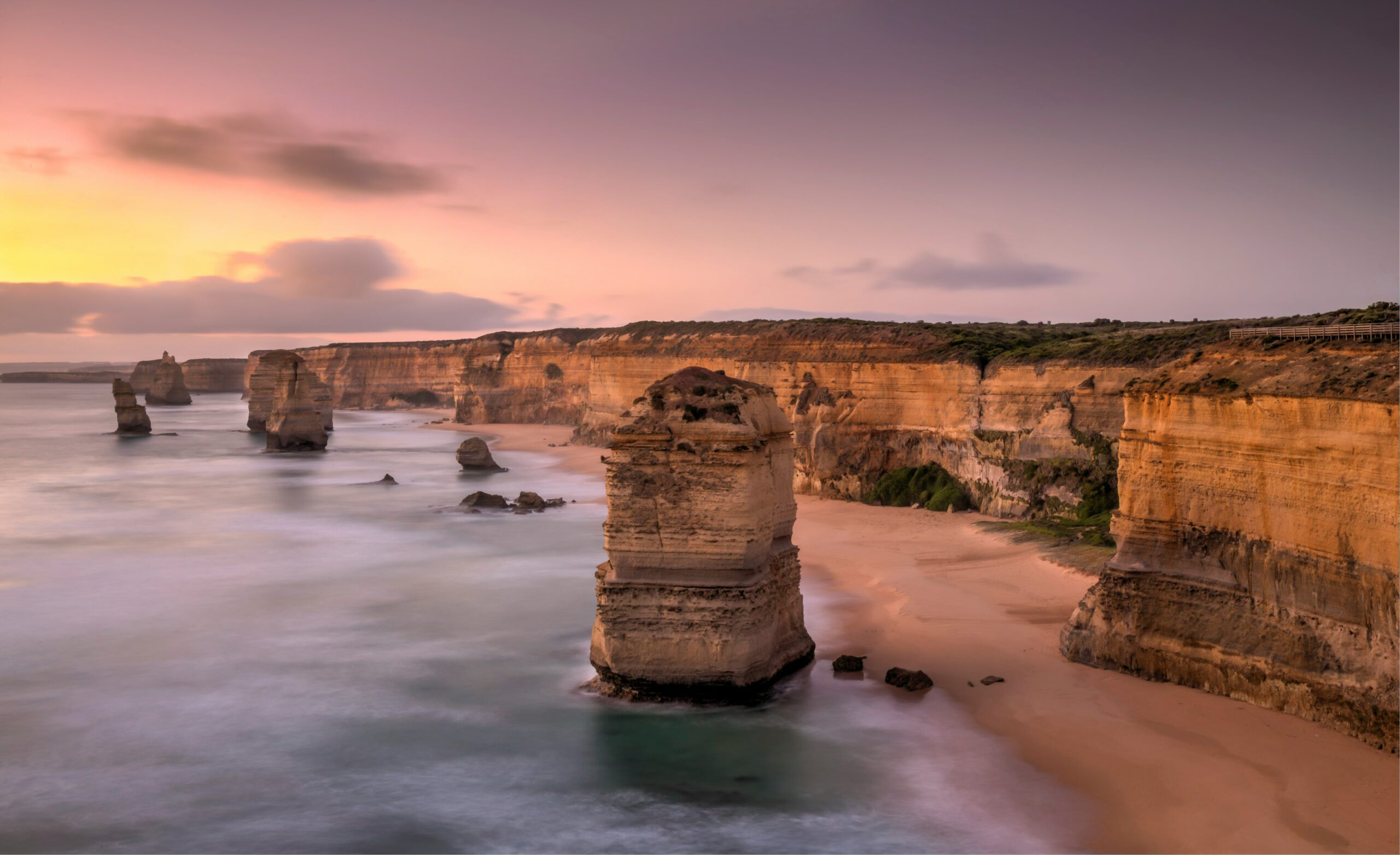
🌊⛰️ The Twelve Apostles
Along Australia’s spectacular Great Ocean Road in the state of Victoria stands one of the most iconic coastal landmarks in the world — The Twelve Apostles. These towering limestone stacks rise dramatically from the Southern Ocean, sculpted over millions of years by the relentless forces of wind, waves, and time. Although their name suggests a dozen, there were never exactly twelve visible stacks — today, fewer remain standing due to ongoing erosion — but their fame, beauty, and symbolism remain timeless.
The Twelve Apostles are a perfect example of nature’s breathtaking artistry, forged slowly through patience and power. To stand before them is to feel both the vastness of our planet and the fragility of everything on it.
A Coastline Carved by Time and the Wild Sea
The story of the Twelve Apostles begins around 10 to 20 million years ago when the region was submerged beneath an ancient sea. Layers of marine life — shells, coral, sand — compacted and formed soft limestone. When sea levels fell, the coastline emerged, revealing cliffs vulnerable to erosion.
The Southern Ocean, known for its fierce weather, began its sculpting:
-
First forming caves in the cliffs
-
Caves deepened into arches
-
Eventually, arches collapsed into isolated pillars — the apostles we see today
This process continues. Every collapse marks an end and a beginning — a loss of one formation creates rubble that may someday rise again as a new stack.
The tallest pillar stands over 45 meters high — taller than a 15-story building — reminding us of nature’s scale and grandeur.
Why Are They Called the Twelve Apostles?
Interestingly, the name is more poetic than literal. Originally, these formations were referred to as:
-
“The Sow and Piglets” in early European references
-
The Sow being the main cliff, and the stacks her piglets
In the 1920s, tourism authorities rebranded them to:
“The Twelve Apostles”
because the new name sounded more majestic and spiritual — appealing to global audiences.
Even though only nine stacks were recognized when the name was adopted and now fewer remain, the name stuck. It reflects the grandeur of the site rather than a specific count.
Nature’s Ever-Changing Masterpiece
Because the limestone is soft, erosion shapes the apostles constantly. On July 3, 2005, one of the stacks collapsed — a rare moment caught on video by tourists. More stacks will eventually fall, and new ones may appear.
So, the apostles are:
-
Ancient yet temporary
-
Solid yet fragile
-
Constant yet continuously transforming
This duality is part of their mystique — they are a living, changing sculpture.
The Great Ocean Road: One of the World’s Most Scenic Drives
Most visitors reach the Twelve Apostles by driving the 243 km Great Ocean Road, a road with its own proud history. Built by World War I soldiers between 1919–1932, it was dedicated as a memorial to fallen comrades — making it the world’s largest war memorial.
Along the way, travelers experience:
-
Rainforests of Otway National Park
-
Koalas resting in eucalyptus trees
-
Surf beaches with dramatic waves
-
Charming coastal towns like Lorne and Apollo Bay
-
Cliff edges where land meets roaring sea
As the apostles come into view, the journey’s emotional build-up makes the sight even more powerful.
Best Viewpoints and Unforgettable Lookouts
The site is designed for breathtaking perspectives:
-
Main Viewing Platform — up-close views from the cliff edge
-
Gibson Steps — stairway to the beach, where waves crash near towering stacks
-
Helicopter Flights — soaring above the coastline like seabirds
-
Loch Ard Gorge — dramatic cove with a tragic shipwreck story
-
The Razorback and Island Arch Lookout — unique rock formations nearby
Every viewpoint reveals different angles, shapes, shadows, and emotional impressions.
Sunrise, Sunset & the Magic of Light
The apostles change personality throughout the day:
-
Dawn — soft gold light paints gentle outlines
-
Midday — waves sparkle under bright blue skies
-
Sunset — cliffs glow fiery red and orange, dramatically backlit
-
Night — stars shine above a dark ocean horizon
Sunset is often the most crowded — photographers consider it one of the world’s most rewarding shooting locations.
Fog, storms, and cloud cover also bring unique moods:
-
Mist makes the stacks appear like ghostly guardians
-
Storm waves explode against cliffs in raw power
-
Rainbow-lit skies contrast with the rough ocean
There is truly no “bad” time to see them — every moment offers different beauty.
Wildlife Along the Shipwreck Coast
The surrounding waters and cliffs teem with life:
-
Little penguins nest along the rocky shores
-
Australian fur seals rest on nearby islands
-
Albatross and seabirds soar overhead
-
Whales migrate past during winter months
-
Wallabies and echidnas roam the heathlands
Nature thrives here — despite the harshness of the environment.
Nearby Natural Wonders
The Twelve Apostles are part of a coastline filled with dramatic attractions, including:
-
London Arch — once a double-arch land bridge, one section collapsed in 1990
-
The Grotto — a peaceful limestone pool accessible by steps
-
Bay of Martyrs — stunning yet historically sorrowful Indigenous site
-
Loch Ard Gorge — named after a shipwreck where only two survived
Each place carries stories — of tragedy, survival, and the timeless power of the sea.
Spiritual and Emotional Meaning
The Twelve Apostles evoke profound feelings in visitors. People describe the experience as:
-
Humbling
-
Reflective
-
Spiritual
-
Awe-inspiring
For some, it symbolizes faith and resilience — rocks standing strong against constant waves. For others, it represents the passage of time and the fragility of existence. The sound of crashing waves creates a natural symphony that clears the mind and opens the heart.
Standing on the viewing deck, gazing at these giants, one may realize:
Nature is the greatest sculptor — and we are temporary witnesses.
Tourism, Conservation, and the Future
The area attracts millions of visitors every year, supporting local communities — but also creating responsibility to protect the fragile environment.
Efforts focus on:
-
Limiting erosion around walkways
-
Restoring native vegetation
-
Managing tourist access to preserve natural features
-
Studying geological changes to predict collapses
The apostles will never be exactly the same from one decade to the next. Their transformation is ongoing — making every visit a moment in history.
Why the Twelve Apostles Are Legendary
| Feature | Significance |
|---|---|
| Dramatic limestone stacks | One of the world’s most photogenic coastlines |
| Located on Great Ocean Road | A historical and scenic adventure |
| Dynamic, evolving landscape | Formations changing with time |
| Symbol of Australian nature | Iconic landmark celebrated globally |
| Spiritual and emotional impact | Inspires awe, reflection, and wonder |
They remind us that the world is still wild — and stunningly beautiful.
The Twelve Apostles are not just rocks in the sea.
They are ancient storytellers, shaped by time and the elements — guardians of the coast who stand proudly against the restless ocean.
Visiting them is something you never forget.
No responses yet